
Categories
AI News

Top 10 Latest AI Breakthroughs in 2025: New Research & Innovations


Artificial Intelligence continues to evolve at an explosive pace, and 2025 has already become a landmark year for breakthrough research, revolutionary product launches, and real-world AI applications. From multimodal AI systems that understand images and sound, to autonomous agents capable of running entire workflows, the newest wave of innovations is redefining how we work, live, build, and create.

In this definitive guide, we explore the Top 10 Latest AI Breakthroughs in 2025—covering cutting-edge technologies, industry trends, startup innovations, and research achievements shaping the future of artificial intelligence.


1. Hyper-Multimodal AI Models (Text + Image + Audio + Video + Action)

One of the biggest breakthroughs in 2025 is the rise of hyper-multimodal AI models—systems that can process and generate multiple types of data at once, including:

  • Text
  • Images
  • Videos
  • Audio
  • Real-world actions via agents
  • 3D environments
  • Live sensor data

Why It’s a Breakthrough

Earlier AI was mostly text-based, but 2025 models can now:

  • Watch a video and summarize it
  • Understand complex diagrams and maps
  • Generate step-by-step video tutorials
  • Analyze audio recordings and convert them to structured data
  • Control software and tools autonomously

This shift represents a major step toward AGI-like capabilities.

Real-World Impact

  • Automated video editing
  • Visual data analysis in healthcare
  • AI-powered product design
  • Smart city monitoring
  • AI tutors that teach using real-time media

Hyper-multimodal AI is now the new industry standard.


2. Autonomous AI Agents Capable of Full Workflow Execution

2025 introduced the era of fully autonomous digital agents—AI tools that complete tasks without human supervision.

These agents can:

  • Plan
  • Execute
  • Review
  • Improve
  • Repeat workflows

Examples of Tasks They Now Handle

  • Running an entire e-commerce operation
  • Managing marketing campaigns
  • Automating booking and customer service
  • Conducting financial research
  • Writing, testing, and deploying code

In 2025, autonomous agents became more reliable and secure, removing the major barrier that held them back in previous years.

Impact on Businesses

Companies are saving up to 60–80% on operational costs by moving repetitive tasks to AI agents.

Startups built around agent-first technology are growing rapidly, turning this into one of the biggest AI opportunities of 2025.


3. Breakthroughs in AI Reasoning and Problem-Solving

A major leap this year came from improvements in reasoning algorithms.

2025 AI models can now:

  • Understand context deeply
  • Perform multi-step calculations
  • Solve logic-based challenges
  • Make decisions with limited data
  • Provide structured analysis

Improved reasoning brings AI closer to human-like understanding, making it trustworthy in areas like:

  • Legal research
  • Scientific analysis
  • Medical reasoning
  • Finance modeling
  • Engineering design

Key Advancement

New reasoning engines combine:

  • Symbolic AI
  • Neural networks
  • Reusable memory systems

This hybrid approach unlocks more accurate decision-making and reduces hallucinations significantly.


4. AI-Powered Drug Discovery & Medical Predictions

Healthcare saw some of the most important breakthroughs in 2025.

AI systems can now:

  • Predict disease risks with >90% accuracy
  • Discover new drug molecules in weeks (not years)
  • Analyze medical images at near-perfect precision
  • Personalize treatment for each patient
  • Simulate drug reactions before human trials

Examples of 2025 Innovations

  • AI-discovered medications entering human trials
  • Faster cancer detection through multimodal models
  • AI-generated synthetic proteins
  • Real-time metabolic simulations

Healthcare AI is saving lives—and reducing the cost of medical innovation globally.


5. Next-Gen AI Chips: Faster, Smaller & Energy Efficient

The hardware side of AI also had record-breaking innovations.

2025 AI Chips Are:

  • 5x faster than 2023’s top models
  • Highly energy efficient
  • Capable of running on mobile devices
  • Designed specifically for AI inference

Why It Matters

With more powerful chips, AI no longer needs cloud servers for everything.

This enables:

  • On-device AI
  • Real-time translation
  • Private and secure processing
  • Faster apps
  • Lower energy use

These new chips are accelerating the global adoption of AI in consumer and enterprise products.



6. Real-Time AI Voice & Video Generation

2025 introduced hyper-realistic AI voice and video generation, unlocking new creative possibilities.

AI can now:

  • Create lifelike avatars
  • Dub voices perfectly in any language
  • Generate cinematic-quality videos
  • Build full animations from text prompts
  • Create virtual humans for customer support

Industries Using It

  • Gaming
  • Film & media
  • Marketing
  • Education
  • Virtual influencers
  • Corporate training

This breakthrough reduces production cost drastically—turning a $50,000 video into a $50 AI generation.


7. AI-Powered Robotics Scaling Across Industries

Robotics surged forward this year thanks to improved AI perception and reasoning.

Modern AI robots can:

  • Navigate complex environments
  • Learn tasks from a single demonstration
  • Manipulate small objects with high precision
  • Collaborate safely with people
  • Run logistics autonomously

Where AI Robots Are Growing Fastest

  • Warehouses
  • Restaurants
  • Construction
  • Hospitals
  • Elder care
  • Agriculture

New general-purpose robots emerged in 2025, capable of completing dozens of tasks—making robotics one of the hottest fields of the year.


8. Long-Context AI Models (Up to 10M+ Tokens)

Another huge leap is long-context models.

2025 AI systems can process:

  • Entire books
  • Full codebases
  • Large research datasets
  • Corporate knowledge bases
  • Massive documents

Benefits of Long-Context AI

  • Better memory
  • Higher accuracy
  • Deeper understanding
  • More consistent outputs
  • Ability to handle enterprise-scale workloads

This breakthrough makes AI truly useful for complex professional environments.


9. AI in Cybersecurity: Autonomous Threat Detection

Cybersecurity AI in 2025 can now:

  • Detect attacks in milliseconds
  • Prevent breaches automatically
  • Analyze attacker behavior
  • Patch vulnerabilities
  • Track malicious patterns globally

Major Innovations

  • AI firewalls
  • Autonomous penetration testing
  • AI-driven encryption
  • Real-time phishing detection

With threats rising worldwide, AI-powered security is becoming essential for every business.


10. AI for Creativity: Design, Music, Code & Business Creation

AI creativity reached new heights in 2025.

AI can now generate:

  • Professional-grade designs
  • Complex music compositions
  • Full apps & websites
  • Business plans & marketing strategies
  • Books, scripts, and animations

Why This Matters

Creative AI tools empower individuals and small businesses to:

  • launch startups faster
  • reduce outsourcing cost
  • improve productivity
  • create content at scale

Creativity is no longer limited by skill—just imagination.


Future Outlook: What’s Coming Next in AI?

Based on 2025 trends, the next wave of AI will include:

  • More self-improving AI models
  • Fully autonomous digital employees
  • Personalized AI companions
  • Smarter AI robots for home & industry
  • Real-time global translation without devices

AI’s growth is exponential, and we’re just at the beginning.


Final Thoughts

The Top 10 AI Breakthroughs of 2025 demonstrate how rapidly artificial intelligence is transforming the world. From multimodal intelligence and autonomous agents to advanced robotics and healthcare innovations, AI is reshaping every industry and unlocking countless opportunities.

Whether you’re an entrepreneur, student, researcher, or business owner, understanding these breakthroughs gives you a competitive edge—and prepares you for the AI-powered future ahead.
 

Categories
business idea

How to Launch an AI-Powered Startup: Step-by-Step Guide for Beginners..


Artificial intelligence is transforming every industry—from healthcare to finance, education, marketing, customer service, and e-commerce. Because of this massive shift, entrepreneurs today have the opportunity to build AI-powered startups faster, cheaper, and more efficiently than at any time in history.

Whether you’re a complete beginner or an aspiring founder with limited technical knowledge, this comprehensive guide will walk you through the full process of launching an AI startup. You will learn how to find your idea, validate it, create an AI-powered MVP, attract customers, and scale your business.


Why AI Startups Are the Future

Artificial intelligence is no longer optional — it’s becoming the foundation of modern business innovation. Companies everywhere are adopting AI to improve efficiency, reduce costs, and enhance customer experiences. Entrepreneurs who understand how to leverage AI now will stand ahead of the competition for years to come.

Reasons AI startups are booming:

  • AI automation reduces operational costs
  • AI tools enable small teams to build large-scale products
  • Businesses demand digital transformation
  • Investors are actively funding AI-first companies
  • AI-based products scale faster than traditional software

In simple terms: AI gives entrepreneurs superpowers.

You don’t need a PhD or coding mastery to start. You only need the right strategy — which this guide provides.


1. Understand What an AI Startup Actually Is

Before building anything, it’s essential to understand what makes an AI startup different from a traditional tech startup.

An AI-powered startup uses artificial intelligence to:

  • automate tasks
  • predict outcomes
  • analyze large amounts of data
  • interact with users (chatbots, assistants)
  • optimize processes

Examples of AI-driven startups:

  • ChatGPT-based customer service assistants
  • AI content generators
  • AI tools for e-commerce product recommendations
  • AI-powered health diagnostic assistants
  • Predictive finance and investment tools
  • Workflow automation platforms

Your startup doesn’t need to build AI from scratch. You can use existing AI models and APIs to build your product faster.


2. Identify a Real Problem AI Can Solve

The biggest mistake new founders make is starting with the technology instead of the problem.

AI should solve a real pain, not just look impressive.

Ask yourself:

  • What problems frustrate people in your industry?
  • Where are businesses losing time or money?
  • Which repetitive tasks could AI automate?
  • Are customers demanding better, faster solutions?

Great AI startup ideas solve problems like:

  • Slow customer service → AI chatbot
  • Inefficient marketing → AI analytics
  • Manual data entry → AI automation
  • Poor sales forecasting → AI predictive models
  • Expensive content creation → AI content tools

Your AI startup idea should make something easier, faster, or cheaper.


3. Validate Your Startup Idea With Real Users

Validation ensures your AI startup solves a real need — before you spend months building it.

Effective validation methods:

1. Customer interviews

Talk to 10–20 potential users and ask:

  • What problems they face
  • What tools they use today
  • How much they would pay for a solution
2. Competitor analysis

If competitors exist, that’s good — it means there’s demand.
Study what they do well and where they fail.

3. Landing page testing

Create a simple website explaining your solution.
Run ads or share it with groups.
Track sign-ups and interest.

4. Prototype demo

Use low-code tools (Bubble, Figma, Webflow) to show a simple example of your solution.

If users show interest early, you’re on the right path.


4. Choose the Right AI Tools and Technologies

You don’t need to build your own AI model. Many successful startups simply use existing APIs.

Beginner-friendly AI tools:

  • OpenAI API – text, image, chat, automation
  • Hugging Face models – speech, vision, NLP
  • Google Vertex AI – enterprise-ready AI
  • Microsoft Azure AI – robust cloud solutions
  • Zapier + AI – no-code automation
  • Bubble AI plugins – build apps without coding

Learn the basics of AI integrations:

  • How APIs work
  • Data privacy
  • Prompt engineering
  • Fine-tuning AI models
  • Using cloud services

Start simple — build first, optimize later.


5. Build an MVP (Minimum Viable Product)

An MVP is a simplified version of your AI tool that solves the core problem.

Your MVP must:

  • Be quick to build (1–4 weeks)
  • Demonstrate AI value clearly
  • Focus only on the main feature
  • Collect user feedback

Examples of AI MVPs:

  • A chatbot answering common questions
  • A dashboard generating automatic reports
  • A content generator for blogs or social media
  • A recommendation tool for e-commerce shops
  • An AI tool that analyzes user data

Use no-code and low-code platforms when possible. Speed matters more than perfection.


6. Build the Right Business Model

Choosing the right business model determines how your AI startup makes money.

Top business models for AI startups:

1. SaaS Subscription

Users pay monthly for access to your AI tool.
Best for: content tools, automation platforms, analytics.

2. Freemium + Paid Upgrades

Basic version is free, advanced features are paid.
Best for: AI writing tools, chatbots, productivity apps.

3. Pay-per-use

Users pay based on API usage or credits.
Best for: AI image generation, data analysis.

4. B2B Enterprise Sales

Sell directly to companies or industries.
Best for: healthcare AI, finance AI, HR AI.

5. White-label or Licensing

Sell your AI model to other businesses to rebrand.
Best for: chatbot platforms, automation tools.

Pick the model that matches your audience’s willingness to pay.


7. Build a Winning Go-To-Market Strategy

Now it’s time to launch.

Your go-to-market (GTM) strategy helps you get your first customers fast.

Essential GTM methods:

1. SEO (Search Engine Optimization)

Write blogs targeting keywords like:

  • AI tools for businesses
  • Best AI automation software
  • How to use AI for productivity
  • AI startup solutions

SEO brings long-term organic traffic.

2. Social Media Marketing

Share educational content on:

  • LinkedIn
  • Twitter (X)
  • Instagram
  • TikTok
  • YouTube

Show your audience how your AI solves problems.

3. Outreach to potential customers

DMs, cold emails, LinkedIn messages.

4. Beta testing community

Offer limited free access to early adopters.
This builds traction, feedback, and testimonials.

5. Paid ads

Perfect if you already validated your idea.

Your launch should be loud enough for your target audience to hear.


8. Optimize and Improve Using User Feedback

AI startups thrive on iteration. Your first version is never the final one.

Gather feedback through:

  • User behavior analytics
  • Feature requests
  • Surveys
  • Direct communication
  • AI performance monitoring

Improve based on:

  • Accuracy
  • Speed
  • UI/UX
  • Pricing
  • Customer support

Remember:
Users care about results, not technology.


9. Scale Your AI Startup

Once you have traction, it’s time to scale.

Scaling strategies:

1. Increase your product features

Add improvements based on user demand.

2. Expand your target market

Move from one niche to a broader audience.

3. Form strategic partnerships

Partner with influencers, consultants, or industry platforms.

4. Hire the right team

Consider hiring:

  • Developers
  • Marketers
  • Sales reps
  • Data specialists

5. Seek funding

When scaling, consider:

  • Angel investors
  • Venture capital
  • AI-focused investment funds
  • Government technology grants

Scaling transforms your startup from a small pilot into a real business.


10. Stay Updated With AI Trends

AI evolves rapidly — what works today may be outdated in six months.

Stay ahead by following:

  • AI research blogs
  • Industry news
  • YouTube channels
  • AI communities on Reddit and Discord
  • Conferences like NeurIPS, Web Summit, or Startup Grind

Founders who adapt fastest grow fastest.


Conclusion: You Can Launch an AI Startup Even as a Beginner

Starting an AI-powered startup may seem intimidating, but this step-by-step guide proves it’s achievable for anyone willing to learn, test, and take action.

Categories
AI News

What Is AI and How It Works? Full Guide for Beginners (2025-2026)


Artificial Intelligence (AI) is one of the fastest-growing technologies in the world today. From smartphones and social media to healthcare and business automation—AI is everywhere. If you want to understand what AI really is and how it works, this beginner-friendly guide will explain everything clearly.


🔍 What Is AI (Artificial Intelligence)?

Artificial Intelligence (AI) is a technology that allows machines or computer programs to think, learn, and make decisions like humans.
Instead of following only fixed instructions, AI can:

  • Learn from data
  • Identify patterns
  • Improve automatically over time
  • Make predictions
  • Solve complex problems

👉 In simple words: AI = Smart machines that learn and think.


🧠 How Does AI Work?

AI systems use different technologies to learn and make decisions. Here are the key components:

1. Machine Learning (ML)

ML helps computers learn from data.
Example: Netflix recommending movies based on your watching history.

2. Deep Learning

A special type of machine learning using neural networks (like the human brain).
Example: Self-driving cars detecting objects on the road.

3. Natural Language Processing (NLP)

AI that understands human language.
Example: ChatGPT, Google Assistant, Siri.

4. Computer Vision

AI that understands images and videos.
Example: Face unlock on smartphones.


🤖 Types of Artificial Intelligence

1. Narrow AI (Weak AI)

  • Designed to perform one task
  • Most AI today
    Examples: Chatbots, YouTube recommendations, spam filters

2. General AI (Strong AI)

  • Can think and learn like a human
  • Still under research

3. Super AI

  • Smarter than humans
  • Only theoretical for now

🌍 Real-Life Examples of AI

AI is already making everyday life easier:

  • 📱 Mobile face unlock
  • 🛒 Personalized shopping suggestions
  • 🚗 Self-driving cars
  • 🏥 AI-based disease detection
  • 💬 Chatbots for customer support
  • 🎮 Game bots
  • 🤖 Robots in factories

📈 Why AI Is Important

AI is shaping the future because it can:

  • Automate tasks
  • Reduce human errors
  • Improve business performance
  • Increase efficiency
  • Save time and money
  • Create new job opportunities

AI is not just helpful—it’s becoming essential for modern technology.


🚀 Future of AI (2025 & Beyond)

In the coming years, AI will grow even more powerful. You can expect:

  • More advanced chatbots
  • Smarter robots
  • AI-powered businesses
  • Better medical technology
  • Improved cybersecurity
  • Fully automated smart homes

AI will change how we work, learn, and live.


📝 Final Thoughts

Artificial Intelligence is the technology of the future. Understanding what AI is and how it works will help you stay ahead in today’s digital world. Whether you are a student, blogger, developer, or business owner—learning AI is a smart decision.


Categories
business idea

How to Make an AI Chatbot: Step-by-Step Guide for Beginners (2025-2026Update)

📌 Introduction

AI chatbots are now everywhere—from customer service and e-commerce to healthcare and daily productivity tools. In 2025, building an AI chatbot has become easier, thanks to powerful no-code platforms and advanced AI models.
This guide will show you how to make an AI chatbot step-by-step, even if you’re a complete beginner.


⭐ What Is an AI Chatbot?

An AI chatbot is a computer program that uses artificial intelligence to understand questions and respond like a human. Modern AI bots use:

  • Natural Language Processing (NLP)
  • Machine Learning
  • Large Language Models (LLMs)
  • Automation tools

These help the bot understand user messages, learn from conversations, and give accurate answers.


🎯 Why You Should Build an AI Chatbot

Creating a chatbot can help you:

  • Reduce customer support load
  • Improve user experience
  • Automate repetitive tasks
  • Increase sales & engagement
  • Build your own AI assistant or business tool

In 2025, businesses using AI chatbots grow 40–70% faster compared to those without automation.


🧩 Types of AI Chatbots

There are mainly 3 types:

1. Rule-Based Chatbots

Respond to predefined commands.

2. NLP-Based Chatbots

Understand human language using machine learning.

3. AI LLM-Based Chatbots (Most Advanced)

Built with models like GPT-4, GPT-5, Gemini, Claude, etc.


🛠 Tools You Need to Make an AI Chatbot in 2025

Here are the best tools for beginners:

1. Chatbot Builder Platforms (No-Code)

  • ChatGPT Builder
  • Botpress
  • ManyChat
  • Tidio
  • Flow XO

2. API-Based Tools (For Developers)

  • OpenAI API
  • Google Gemini API
  • Meta Llama API
  • Rasa
  • Python + NLP Libraries

📘 Step-by-Step: How to Make an AI Chatbot

Step 1: Choose Your Chatbot Purpose

Decide what your bot will do:

  • Customer support
  • Lead generation
  • E-commerce shopping assistant
  • Educational bot
  • Personal AI assistant

Step 2: Select the Right Platform

If you’re a beginner → Use no-code chatbot builder tools
If you’re a developer → Use OpenAI API or Python

Step 3: Create Conversation Flow

Plan:

  • Greetings
  • FAQs
  • User intent
  • Response style

Tip: Keep the bot’s tone friendly and helpful.

Step 4: Train the AI

Add:

  • Example questions
  • Sample conversations
  • Your business information
  • Instructions on how your bot should behave

Step 5: Test the Chatbot

Check:

  • Accuracy
  • Speed
  • Response quality

Step 6: Publish Your Chatbot

You can deploy your chatbot on:

  • Website
  • WhatsApp
  • Messenger
  • Mobile app
  • Telegram
  • WordPress

Step 7: Improve Using Analytics

Track:

  • User messages
  • Drop-off points
  • Common questions
  • Engagement rate

Then update the chatbot for better performance.

📌 Conclusion

Building an AI chatbot in 2025 is easier than ever. Whether you’re a business owner, student, or developer, you can create a powerful AI bot using no-code tools or APIs. Start small, test, improve, and grow your chatbot into a smart AI assistant.


Categories
AI News

Future of AI 2025: Best Updates, Major Upgrades & Smart Tools

Artificial Intelligence is moving faster than ever, and 2025 is set to be the biggest year for AI innovation. From smarter AI assistants to real-time automation, new AI models, robotics, and business tools—everything is getting upgraded.

In this article, we explore the best AI updates of 2025, the major upgrades released this year, and the smart tools that are changing how we live, work, and create.


1. Best AI Updates of 2025

AI companies like OpenAI, Google, Meta, Anthropic, and Apple have launched game-changing updates this year. Below are the highlights:

1.1 More Powerful AI Models

2025 has introduced new-generation models with:

  • Higher reasoning ability
  • Real-time learning
  • Better accuracy
  • Multimodal features (text, voice, image, video)

These models can think deeper, solve complex tasks, and behave more like human experts.

1.2 AI with Real-Time Search & Internet Access

Many AI tools now come with:

  • Live internet browsing
  • Social media data reading
  • Real-time fact-checking

This makes AI more reliable and up-to-date.

1.3 AI Agents (Auto-Working AI Tools)

2025 is the year of AI agents—systems that work automatically without human input.

They can:

  • Write emails
  • Do research
  • Create reports
  • Fix code
  • Automate business workflows

Almost like hiring a virtual employee.


2. Major AI Upgrades in 2025

2.1 AI in Smartphones

Brands like Apple, Samsung, and Google added:

  • On-device AI processing
  • AI camera enhancement
  • Live translation
  • Personalized AI assistants

Smartphones are turning into pocket-sized personal AI partners.

2.2 AI in Business Automation

Businesses are using AI for:

  • Accounting
  • Marketing
  • Customer support
  • Sales automation
  • Predictive analytics

This reduces costs and boosts performance.

2.3 AI in Education

2025 brings smarter AI for learning:

  • Personalized learning apps
  • Real-time guidance
  • AI tutors with voice + video
  • Smart exam preparation tools

Students learn faster and more efficiently.

2.4 AI in Healthcare

Upgrades include:

  • AI diagnosis
  • Predictive treatment
  • Medical imaging accuracy
  • AI hospital assistants

Healthcare is becoming more precise and accessible.


3. Best Smart AI Tools of 2025

3.1 AI Writing & Content Tools

  • ChatGPT 5.1
  • Jasper AI
  • Notion AI
  • Copy.ai

These tools create content, articles, ads, emails, and more.

3.2 AI Image & Video Tools

  • Midjourney 7
  • Adobe Firefly 3
  • Runway ML Gen-3
  • Pika Labs

They help in designing, filmmaking, and creative work.

3.3 AI Business Tools

  • Salesforce Einstein
  • HubSpot AI
  • Zoho AI
  • Microsoft CoPilot

These tools automate sales, marketing, and workflows.

3.4 AI Developer Tools

  • GitHub Copilot X
  • Codeium
  • Replit AI

Coding is becoming faster, more accurate, and beginner-friendly.


4. How AI Will Shape the Future (2025 & Beyond)

2025 marks the start of a new AI era with:

  • Fully automated digital workplaces
  • Smarter robots
  • AI-powered homes
  • Personalized AI agents for everyone
  • Real-time global language translation
  • AI making decisions in finance, healthcare & education

The world is moving toward AI-powered living, where machines handle tasks, and humans focus on creativity and strategy.


5. Final Thoughts

The Future of AI in 2025 is exciting and full of innovation. With massive updates, smart tools, and new-generation AI models, technology is getting more powerful, more accessible, and more human-like.

If you want to stay ahead in the AI world, keep following the latest updates and start using AI tools in your daily life.


Categories
AI News

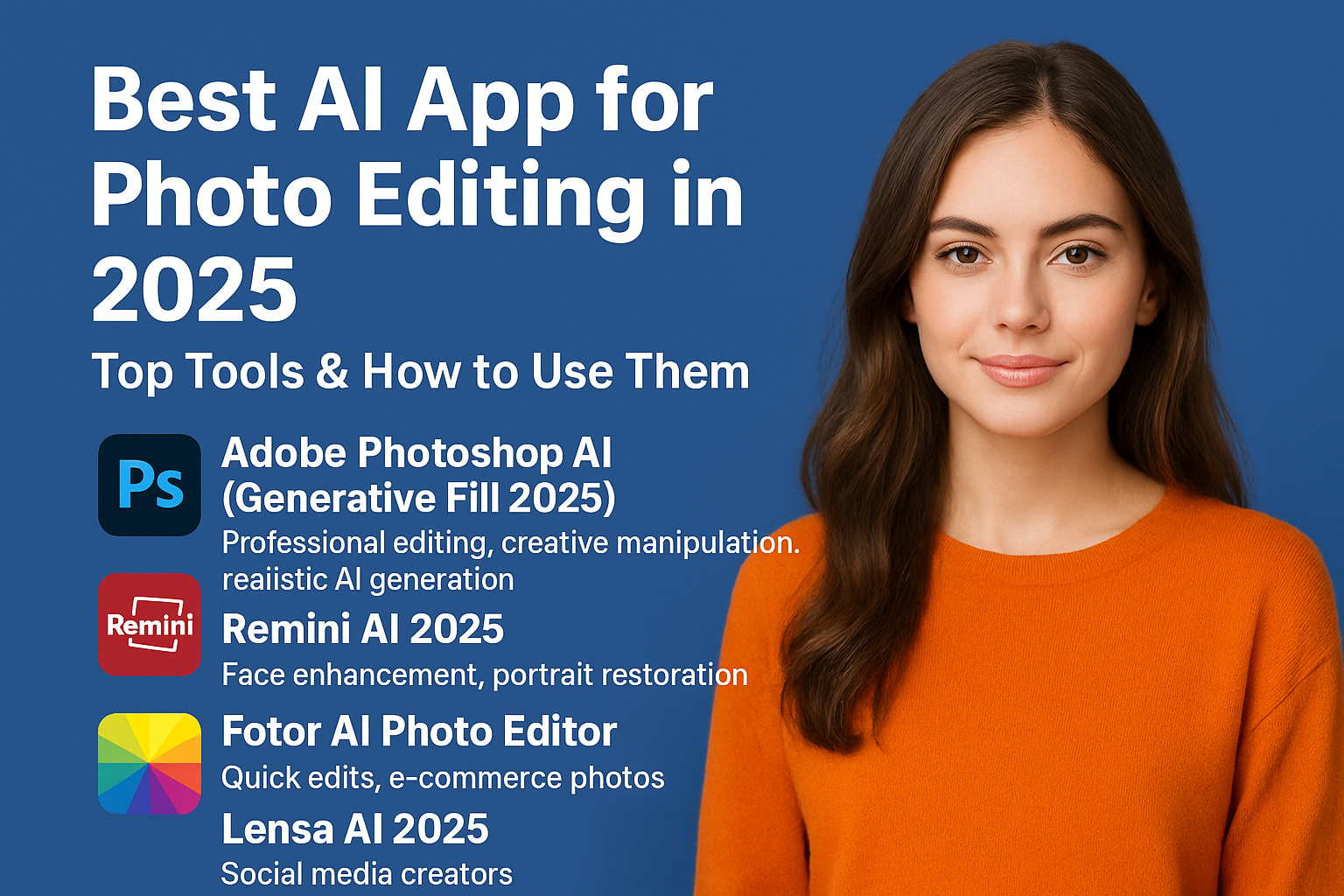
Best AI App for Photo Editing in 2025 – Top Tools to Transform Your Photos


Website: IdeaReachAI.com

In 2025, AI photo editing has reached a whole new level. Whether you are a content creator, photographer, influencer, or business owner, AI-powered editors can now retouch images, remove backgrounds, enhance quality, and create studio-level results in seconds. If you’re searching for the best AI app for photo editing in 2025, this guide highlights the top tools you should try.


1. Adobe Photoshop AI (Generative Fill 2025)

Best for: Professional editing, creative manipulation, realistic AI generation
Photoshop’s latest AI upgrade offers smarter generative fill, auto-object cleanup, and high-resolution face reconstruction. It remains the strongest all-in-one AI editing software in the world.

Top Features:

  • AI object removal
  • Background replacement
  • Smart generative fill
  • Portrait enhancer

2. Remini AI 2025

Best for: Face enhancement, portrait restoration
Remini has become extremely popular for turning low-quality images into HD. In 2025, its AI engine now supports natural skin tones and cinematic effects.

Top Features:

  • Photo HD enhancement
  • Face refresh
  • AI avatar generator
  • Age & style filters

3. Fotor AI Photo Editor

Best for: Quick edits, e-commerce photos
Fotor continues to be a fast and powerful tool for product photos, portraits, and color correction.

Top Features:

  • AI background remover
  • AI retouch
  • Photo enhancer
  • Color & exposure correction

4. Lensa AI 2025

Best for: Social media creators
Lensa remains one of the top choices for influencers who want aesthetic portraits and stylized edits.

Top Features:

  • AI face reshaping
  • Portrait lighting
  • Skin retouch
  • Magic avatars

5. PicsArt AI Studio

Best for: Creative edits & filters
PicsArt’s AI-powered tools make it easy to create unique, eye-catching photos.

Top Features:

  • AI filters
  • Background replacer
  • Collage maker
  • Creative photo effects

🎯 Which AI Photo Editor Is Best in 2025?

  • For professionals: Adobe Photoshop AI
  • For portraits/face: Remini
  • For quick social edits: Lensa
  • For product photos: Fotor
  • For creative designs: PicsArt

Each app has its strengths, so the “best AI photo editor” depends on what kind of editing you need.

see this viedo….

👉 https://www.youtube.com/watch?v=8U0Dv46GOJE


🔍 Conclusion

AI photo editing is evolving faster than ever, and in 2025, you can create stunning, professional-level images without advanced skills. These apps make editing simple, powerful, and accessible for everyone.